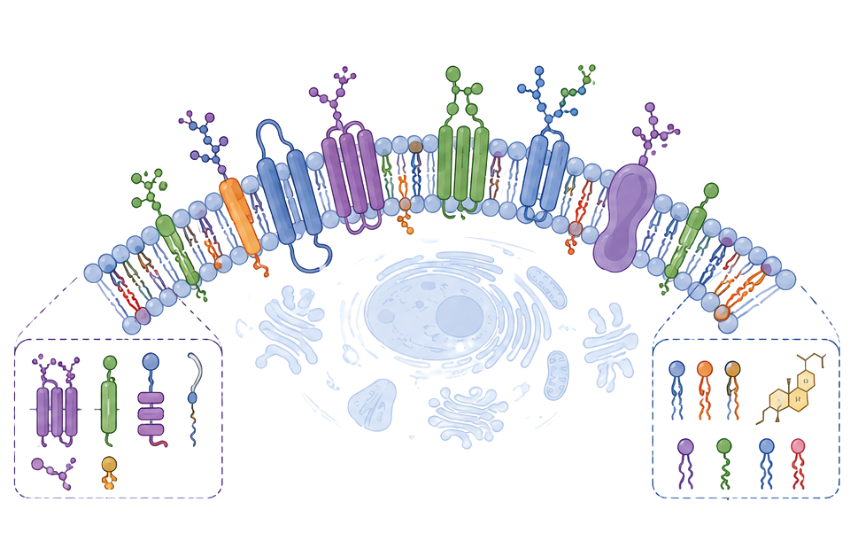
- Integrated cell surface multi-omics service simultaneously profiling the surface proteome and membrane lipidome from the same enriched membrane fraction — delivering a complete, coordinated picture of cell surface biology from a single experiment.
- Paired LC-MS–based proteomics and lipidomics providing high-confidence measurement of cell surface proteins and membrane lipids with the analytical depth and reproducibility required for discovery and mechanistic research.
- Uniquely integrated cell surface platform enabling direct cross-layer interpretation of protein-lipid coupling at the membrane, supporting therapeutic target discovery, membrane biology research, and Next-Generation multi-omic studies.
Reveal the coordinated biology of the cell surface with Panome Bio’s Cell Surface Multi-Omics.
Panome Bio’s Cell Surface Multi-Omics service goes beyond producing two parallel datasets. Our integrated analysis pipeline cross-references significantly altered surface proteins against the parallel membrane lipidomic data, drawing on literature-documented biological associations to identify protein–lipid pairs with functional significance. The result is a systems-level model of cell surface remodeling — revealing not just what changed, but how changes in the protein and lipid layers are related.
Surface proteins are annotated by membrane topology class using the Surface Protein Annotation Tool (SPAT) database, and lipids are identified with high confidence using our computational identification pipeline. Differential analysis is performed independently on both layers, and integration is achieved through both signal-level co-analysis and network-level mapping onto membrane biology frameworks — including lipid raft organization, GPI-anchored receptor partitioning, and phospholipid-dependent signaling pathways.
Advantages of Cell Surface Multi-Omics:
- Deeper biological insight through cross-layer integration: protein changes are interpreted in the context of the membrane lipid environment that regulates their localization, stability, and function.
- Magnified discovery power: concordant changes across both the protein and lipid layers provide greater confidence in biological findings and more actionable mechanistic hypotheses.
- Directly relevant to therapeutically important biology including lipid raft remodeling, ADC and CAR-T antigen surface expression, ferroptosis-associated lipid peroxidation, and immune evasion mechanisms.
- Uniquely positioned to identify protein–lipid coupling relationships that are undetectable by either proteomics or lipidomics alone.
- Seamlessly integrates with Panome Bio’s broader multi-omics portfolio — including transcriptomics, global metabolomics, and discovery proteomics — for comprehensive pathway-level analysis.
Coordinating protein and lipid remodeling in KRAS-knockdown HCT-116 cells
Learn how cell surface proteomics and membrane lipidomics are combined for a deeper understanding of membrane biology.
Analysis of HCT-116 KRAS-Knockdown and Wild-Type Membrane Fractions
Dive into the cell surface multi-omics data report for pathway-level insights in cancer research.
Let’s get started!
Discover the unparalleled advantages of Panome Bio’s advanced proteomics technology. With a comprehensive view of the proteome, the experts at Panome Bio can perform robust proteomics analyses, profile unknown peptide variants, and achieve insights that were previously not possible.
Ready to elevate your research? Connect with us today and transform your proteomics outcomes.