February 25, 2026
Advancing Untargeted Metabolomics Data Analysis with MassID™ MassID™ is Panome Bio’s identification engine for Next-Generation Metabolomics®, designed to turn complex untargeted metabolomics data into confident metabolite identifications. By evaluating detected signals against a reference database of over 280,000 compounds and assigning quantitative confidence scores, MassID supports broader pathway analysis and reproducible biological conclusions.
February 24, 2026
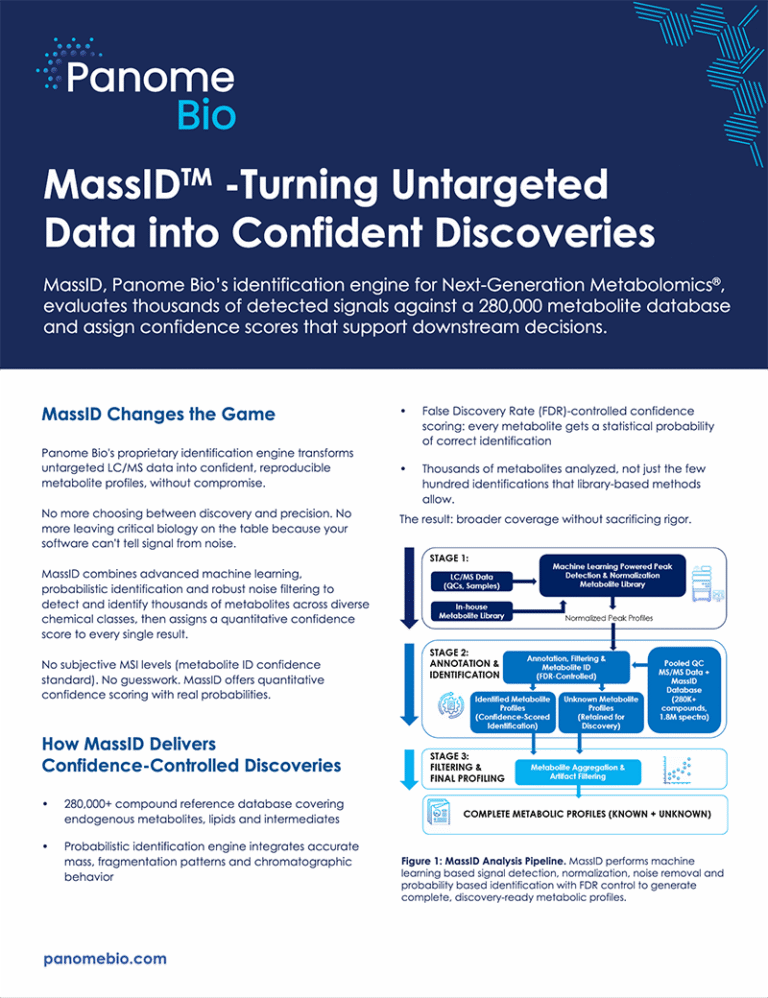
MassID™ Turning Untargeted Data into Confident Discoveries Get a quick overview of how MassID enhances Panome Bio’s true untargeted metabolomics by transforming raw LC-MS/MS data into high-confidence, biologically interpretable metabolite profiles using advanced, probability-based identification.
February 19, 2026
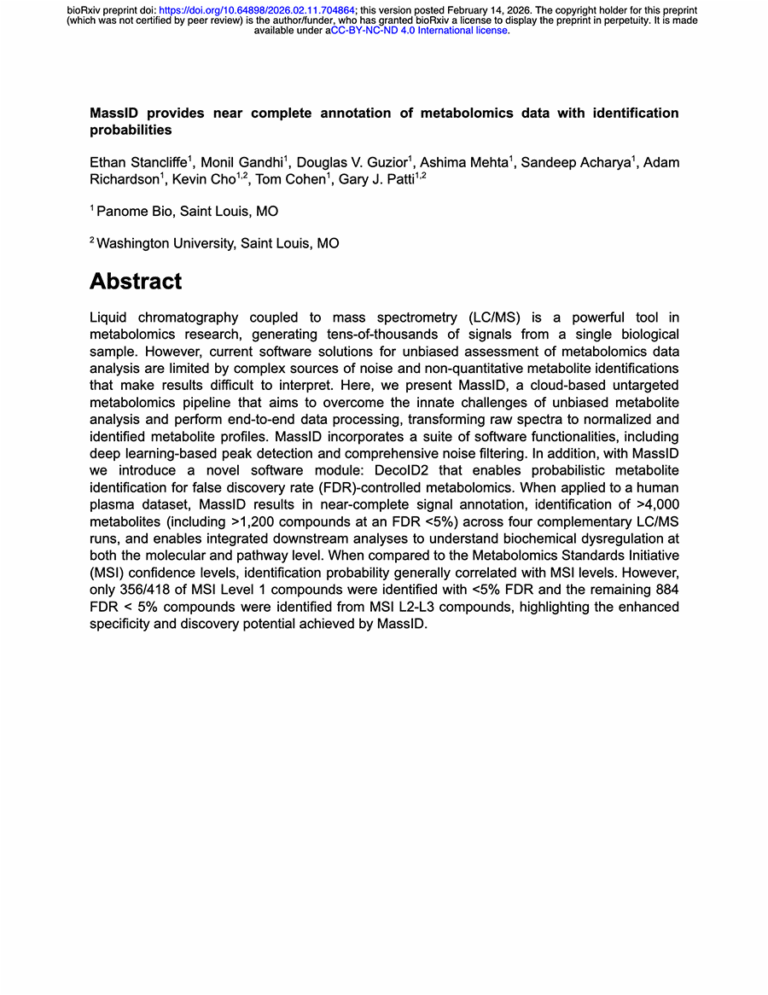
MassID is a computational tool that enables near-complete annotation of untargeted metabolomics datasets by assigning identification probabilities to detected features. Traditional workflows often leave many metabolites unannotated, limiting downstream biological interpretation. MassID overcomes these limitations, improving confidence in metabolite identification and supporting research in systems biology, biomarker discovery, and metabolomics-driven insights. MassID, Panome Bio’s identification […]

January 21, 2026
The functional foods market has expanded rapidly over the past two decades, driven by consumer interest in products offering health benefits beyond basic nutrition. However, this growth has outpaced the scientific evidence supporting many product claims, creating regulatory scrutiny and consumer skepticism that threaten market credibility. Traditional approaches to demonstrating functional food efficacy rely heavily […]

January 12, 2026
The Precious Sample Challenge in Clinical Research Clinical and translational research frequently confronts a fundamental constraint: limited biological sample availability. Pediatric studies, rare disease investigations, longitudinal monitoring protocols, and tissue biopsies all generate precious specimens that must yield maximum information from minimal material. Legacy metabolomics and lipidomics approaches often require substantial sample volumes, forcing researchers […]

January 12, 2026
Payload to Patient: Metabolomics in ADC and Immuno-Oncology In this episode of the ChatGJP series, Panome Bio CSO Dr. Gary J. Patti joins Chris Eden to explore real-world applications of metabolomics in antibody–drug conjugates (ADCs) and immuno-oncology. The discussion covers how untargeted metabolomics can identify early biomarkers of drug efficacy and toxicity, stratify tumors based […]

December 17, 2025
The Critical Challenge of Model Validation in Alzheimer’s Drug Development The pharmaceutical industry faces a persistent challenge in neurodegenerative disease research: ensuring that preclinical models accurately recapitulate the complex biochemical landscape of human disease. For Alzheimer’s disease (AD), where clinical trial failure rates exceed 99%, the stakes of model selection have never been higher. While […]
December 16, 2025
Untargeted Metabolomics in Food Science: Key Applications Untargeted metabolomics is rapidly transforming food science and nutrition research, enabling deeper insight into ingredient quality, processing effects, safety, and nutritional value. In this white paper, we outline some major applications of untargeted metabolomics across food analysis and product development, demonstrate how comprehensive molecular profiling uncovers hidden biochemical […]

December 11, 2025
The Emerging Importance of Host-Microbiome Metabolic Crosstalk The human microbiome has emerged as a critical regulator of health and disease, influencing metabolism, immunity, neurological function, and therapeutic responses. While metagenomic sequencing reveals which microbial species are present, understanding their functional impact requires measuring the metabolites they produce and how these compounds affect host physiology. Microbial […]

December 10, 2025
Standard nutritional labeling requirements mandate quantification of macronutrients, select vitamins, minerals, and energy content—a subset of compounds representing perhaps one percent of the total chemical diversity present in food products. While this reductionist approach serves regulatory purposes and consumer information needs, it provides an incomplete representation of food composition that inadequately captures the bioactive compounds, […]