
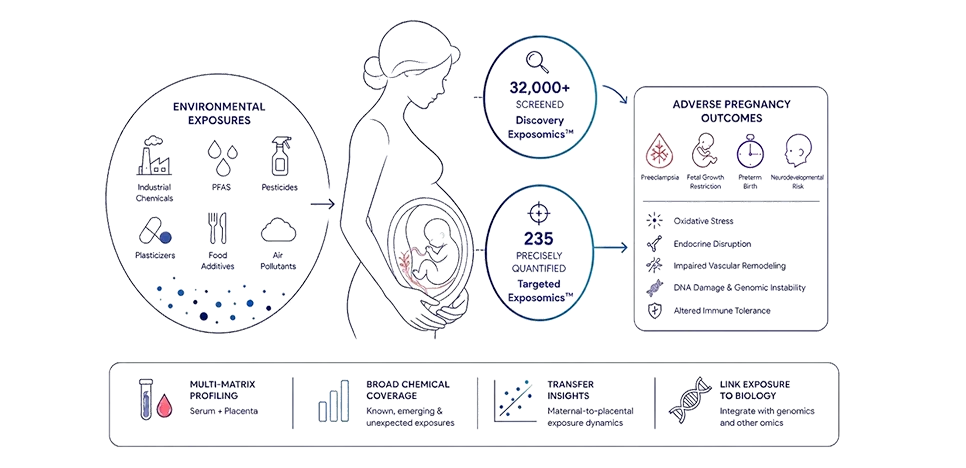
Pregnancy Is More Than Genetics
Pregnancy is often discussed through the lens of hormones, genetics and fetal development. But there is another layer influencing maternal and fetal health that researchers are increasingly paying attention to: environmental chemical exposure.
Every day, people encounter thousands of chemicals through food, water, air, personal care products and the built environment. During pregnancy, many of these compounds can interact with maternal circulation and, in some cases, reach placental tissue.
The placenta is not simply a passive barrier. It is a highly active organ responsible for nutrient transfer, immune signaling, vascular remodeling and fetal protection. When placental biology is disrupted, the effects can contribute to disorders such as preeclampsia, fetal growth restriction and preterm birth.
Recent studies continue to connect placental dysfunction with oxidative stress, hypoxia and altered trophoblast biology (DOI: 10.1016/j.placenta.2018.03.003; DOI: 10.1111/tra.12130).
So, an important question emerges:
Could chemical exposure help explain why some pregnancies remain healthy while others develop complications?
What Is the Pregnancy Exposome?
The “exposome” refers to the total collection of environmental exposures experienced throughout life. In pregnancy research, exposomics focuses on measuring external chemicals and understanding how they interact with maternal and placental biology.
This includes:
- PFAS
- Pesticides
- Industrial contaminants
- Food additives
- Consumer product ingredients
- Environmental metabolites
Unlike traditional toxicology studies that focus on predefined compound lists, exposomics allows researchers to study mixtures of exposures simultaneously.
That distinction matters because real-world exposure rarely happens to one chemical at a time.
Why Researchers Are Looking More Closely at the Placenta
The placenta provides a unique biological record of environmental interaction during pregnancy.
In a recent maternal–placental exposomics study, approximately half of quantified environmental exposures were detectable in both maternal serum and placental tissue. This overlap suggests that the placenta may serve not only as a physiological interface, but also as a measurable archive of maternal chemical exposure.
For researchers studying adverse pregnancy outcomes, that creates an opportunity to investigate environmental contributions directly within pregnancy-associated tissue.
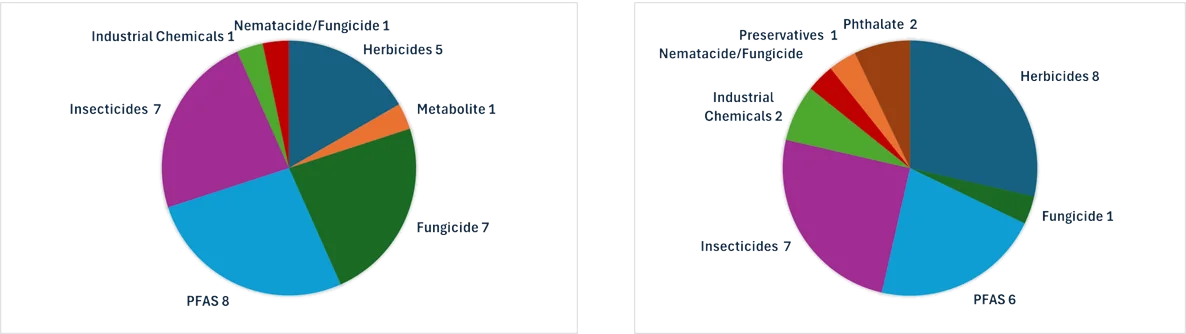
Figure 1: Comparison of detected chemical categories in Targeted Exposomics™ of maternal serum (left) versus placental tissue (right), highlighting shared and tissue-specific exposure profiles.
PFAS and Maternal–Placental Transfer
Among the compounds detected across both serum and placental tissue were several PFAS species, including:
- PFOS
- PFHxS
- PFBS
PFAS are persistent environmental contaminants widely studied for their potential health effects. Their detection in both maternal circulation and placental tissue highlight the importance of understanding maternal-to-placental transfer dynamics.
Environmental exposure research has increasingly linked prenatal chemical exposure with reproductive and developmental outcomes (DOI: 10.1097/AOG.0000000000004449).
For pregnancy researchers, these findings raise important mechanistic questions:
- Which chemicals accumulate in placental tissue?
- How do they influence placental biology?
- Could exposure burden contribute to disease susceptibility?
Looking Beyond Targeted Toxicology Panels
One of the challenges in environmental health research is that targeted assays can only measure compounds researchers already expect to find.
That is where discovery-scale exposomics becomes especially valuable.
Using broad chemical screening approaches, researchers can detect thousands of additional compounds across maternal serum and placental tissue, including:
- Fragrance compounds
- Food additives
- Consumer product chemicals
- Previously uncharacterized environmental exposures
In this study, compounds associated with consumer and food-related exposure patterns were observed at altered abundance in adverse pregnancy outcome groups, demonstrating how untargeted workflows can reveal biology that may otherwise remain hidden.
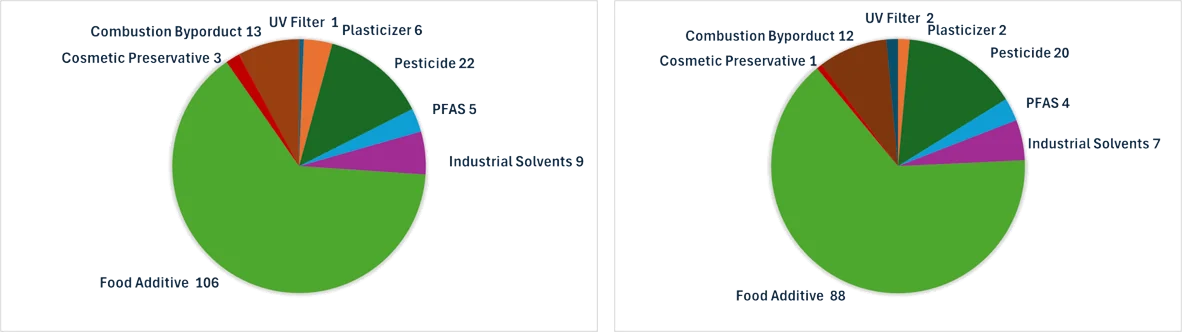
Figure 2: Comparison of detected chemical categories in Discovery Exposomics™ of maternal serum (left) versus placental tissue (right), highlighting diverse chemical classes, including consumer, food-related and previously uncharacterized compounds.
Environmental Exposure and Preeclampsia
Preeclampsia remains one of the most serious complications of pregnancy and continues to rise in prevalence. The increase has occurred too rapidly to be explained by genetics alone, prompting growing interest in environmental and lifestyle-associated contributors (DOI: 10.1001/jama.2024.8931).
Environmental chemicals linked to oxidative stress, endocrine disruption and inflammatory signaling are increasingly being investigated for their potential role in placental dysfunction.
At the same time, researchers are moving toward multi-omics approaches that integrate:
- Exposomics
- Metabolomics
- Proteomics
- Transcriptomics
Together, these technologies make it possible to study pregnancy as a dynamic interaction between maternal biology, placental function and environmental exposure.
Why Exposomics Matters in Maternal–Fetal Research
Chemical exposures are measurable. More importantly, they are biologically relevant.
Exposomics provides researchers with tools to investigate how chemical burden intersects placental biology and adverse pregnancy outcomes at a systems level rather than through isolated biomarkers alone.
For maternal–fetal health research, this opens new directions in:
- Preeclampsia research
- Placental toxicology
- Environmental epidemiology
- Biomarker development
- Reproductive toxicology
- Multi-omic disease modeling
Pregnancy does not occur separately from the environment surrounding it.
Understanding pregnancy increasingly means understanding exposure.
Frequently Asked Questions
What is exposomics and how does it apply to pregnancy research?
Exposomics is the systematic measurement of environmental chemical exposures and their biological effects; applied to pregnancy, it examines how chemical exposures interact with maternal biology and placental function to influence pregnancy complications, treating pregnancy as a dynamic system rather than relying on isolated biomarkers alone.
How much overlap exists between environmental chemicals detected in maternal serum and in placental tissue?
In Panome Bio’s analysis, approximately 50% of quantified environmental exposures were detectable in both maternal serum and placental tissue, including PFAS compounds such as PFOS, PFHxS, and PFBS, showing that many chemicals a mother is exposed to also reach the placenta directly.
How does studying chemical mixtures differ from traditional pregnancy toxicology panels?
Traditional toxicology panels typically test for a limited list of individual known chemicals, while exposomics captures thousands of compounds simultaneously, including previously uncharacterized exposures, allowing researchers to study real-world chemical mixtures rather than single substances in isolation.
What pregnancy-related research areas can exposomics data support?
Exposomics data can open new research directions in preeclampsia, placental toxicology, and broader reproductive toxicology by revealing how the combined chemical burden crossing the placenta intersects with the biological pathways underlying adverse pregnancy outcomes.
How does Panome Bio combine exposomics with other omics layers for maternal-fetal health research?
Panome Bio offers both targeted and discovery-scale exposomics services and can integrate this exposure data with metabolomics, proteomics, and transcriptomics, supporting a systems-level view of how environmental chemical burden and underlying biology jointly shape pregnancy outcomes.