
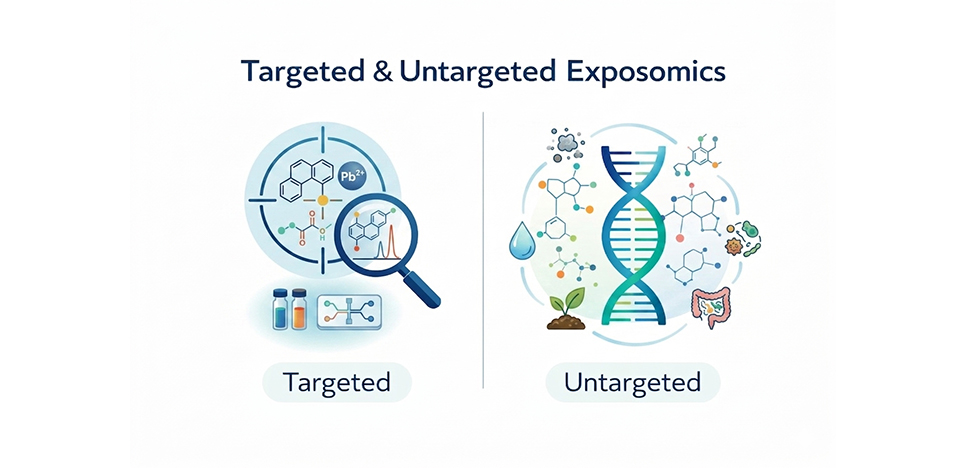
In exposomics, there are two fundamentally different ways to explore the chemical world influencing human health and choosing the right one can make or break your study.
Think of it like this: Are you searching for something specific or are you trying to discover what you don’t yet know exists?
That’s the difference between targeted and untargeted exposomics.
Targeted Exposomics: When You Know What You’re Looking For
Targeted exposomics is all about focus. You start with a defined list of environmental chemicals and measure them with precision using validated, quantitative methods.
We’re talking about well-known culprits like:
- PFAS (“forever chemicals”)
- Agricultural pesticides
- Phthalates (plasticizers)
- Polycyclic aromatic hydrocarbons (PAHs)
These are chemicals with established links to human health, regulatory attention or known exposure risks.
Because the methods are optimized specifically for these compounds, you get:
- High sensitivity
- Accurate quantification
- Data you can compare across studies and standards
The result? Highly sensitive, quantitatively accurate data that connects directly to known biology and exposure sources.
Best for:
- Hypothesis-driven studies
- Biomarker validation
- Clinical and regulatory alignment
- Situations where you already know the suspects
Untargeted Exposomics: When You Don’t Know What You’re Missing
Untargeted exposomics flips the script.
Instead of starting with a list, you cast a wide net, using high-resolution mass spectrometry to detect thousands of chemical signals across a sample.
No assumptions. No predefined targets.
This is where things get exciting.
Untargeted approaches can uncover:
- Previously unknown environmental exposures
- Hidden metabolites of known compounds
- Unexpected chemical differences between patient groups
In diseases where environmental drivers are unclear, this discovery power becomes a major advantage, opening the door to insights that would otherwise remain hidden.
While this breadth introduces additional layers of analysis, it also brings opportunity:
- Expanding the landscape of detectable signals beyond known compounds
- Enabling exploration even when reference standards are limited
- Leveraging advanced computational tools to extract meaningful patterns
In short: you gain powerful discovery capabilities, supported by increasingly sophisticated analytical and bioinformatics approaches.
Best for:
- Early-stage research
- Hypothesis generation
- Complex or poorly understood diseases
- Finding what others haven’t looked for
Discovery or Precision: What’s the Right Fit?
It depends on where you are on your research journey.
- Exploring a new disease area? Start untargeted.
- Validating a known exposure? Go targeted.
- Moving from discovery to application? Use both.
A common (and powerful) strategy:
- Start broad with untargeted screening to identify signals
- Zoom in with targeted methods to quantify and validate
Hybrid Approaches: Measuring the Chemical Drivers of Disease
For many pharmaceutical applications, the answer isn’t either/or. It’s both.
Hybrid strategies combine:
- A curated panel of high-priority chemicals
- With enough breadth to capture real-world exposure diversity
This approach balances:
- Depth (quantitative accuracy)
- Breadth (coverage of relevant exposures)
- Practical constraints (cost, timeline, sample availability)
It’s especially useful for:
- Clinical trial samples
- Retrospective studies
- Situations where you need clear answers, without overwhelming complexity
Panome Bio’s Exposomics Solutions
At Panome Bio, we support both targeted and discovery exposomics approaches, along with flexible strategies that combine the strengths of each.
- Targeted panels for high-confidence, quantitative insights
- Discovery workflows for uncovering novel chemical signals
- Hybrid solutions designed for diverse research needs
Ultimately, the question isn’t targeted vs. untargeted. It’s what will move your research forward fastest.
Let’s define the approach that fits your research goals. Connect with our team to explore targeted, untargeted, or hybrid exposomics strategies.
Frequently Asked Questions
What is the difference between targeted and untargeted exposomics?
Targeted exposomics measures a predefined list of known environmental chemicals — such as PFAS, pesticides, phthalates, and PAHs — using validated, highly sensitive quantitative methods. Untargeted exposomics uses high-resolution mass spectrometry to detect thousands of chemical signals without predetermined targets, enabling discovery of unknown or unexpected exposures.
When should a researcher choose untargeted exposomics over a targeted panel?
Untargeted exposomics is best suited for early-stage research, hypothesis generation, and studies of complex or poorly understood diseases, where the goal is discovering unknown environmental exposures rather than confirming exposure to chemicals already suspected of playing a role.
When is targeted exposomics the better choice for a study?
Targeted exposomics fits hypothesis-driven studies, biomarker validation, and research requiring clinical or regulatory alignment, where researchers already know which chemicals matter and need precise, validated quantification of those specific compounds.
What is a hybrid exposomics strategy and why would a study use one?
A hybrid exposomics strategy starts with broad untargeted screening to discover unexpected chemical exposures, then follows up with targeted validation methods to precisely quantify the specific compounds identified as relevant — combining the discovery power of untargeted analysis with the precision of targeted methods.
What exposomics services does Panome Bio offer?
Panome Bio offers targeted exposure panels, untargeted discovery workflows, and hybrid solutions, allowing researchers to match the analytical approach to their specific study stage and objectives rather than being locked into a single exposomics method.