
For 20 years, genomics has promised precision medicine. And it delivered. For rare diseases and select cancers.
But for most chronic conditions?
Genetics explains only a fraction of risk.
Type 2 diabetes. Alzheimer’s disease. Autoimmune disorders. Metabolic syndrome.
The missing piece isn’t hidden in undiscovered genes. It’s in the chemical world around us.
Welcome to the exposome.
The Problem: We’ve Been Measuring Only Half the Equation
The Human Genome Project transformed biology. But genetics typically explains just 10–30% of disease risk for common conditions.
That leaves a massive gap.
Twin studies and genome-wide association analyses consistently show that most variability in disease risk is not inherited, it’s environmental.
Air. Water. Food. Consumer products. Occupational chemicals. Persistent pollutants.
These factors account for an estimated 70–90% of disease drivers not explained by genetics.
Yet most research studies never measure them.
What Is Exposomics?
Exposomics is the systematic measurement of environmental chemical exposures and their biological effects.
It builds on mass spectrometry–based metabolomics but shifts the focus:
Instead of treating environmental chemicals as background noise, exposomics measures them directly.
Traditional metabolomics primarily characterizes endogenous metabolites, lipids, amino acids, organic acids, and signaling molecules that reflect internal physiology.
Exposomics expands this analytical window to include exogenous compounds and their biotransformation products, integrating environmental chemistry into metabolomic workflows.
That includes:
- PFAS “forever chemicals”
- Pesticides and agricultural residues
- Plasticizers and industrial solvents
- Flame retardants
- Food additives
- Combustion byproducts
- Pharmaceutical residues
- Emerging contaminants
Modern environmental metabolomics platforms can detect thousands of exogenous compounds in human biospecimens, often at trace levels.
Using high-resolution LC–MS technology, these platforms simultaneously capture endogenous metabolic shifts and external chemical burdens in a single analytical framework.
For the first time, researchers can profile the chemical burden individuals carry in their blood.
Why This Matters for Drug Development
Pharmaceutical companies regularly observe something puzzling:
A drug performs well in one population… But underperforms in another.
Geographic variation in trial outcomes is often blamed on genetics.
But environmental chemical exposure profiles differ dramatically across regions and they influence:
- Drug metabolism
- Immune tone
- Inflammation
- Hormone signaling
- Mitochondrial function
- Disease progression
If two patients share the same genome but carry very different PFAS or pesticide burdens, their biological baseline is not the same.
That difference can alter therapeutic response.
Where Exposomics Fits in the Pipeline
Environmental chemical profiling supports drug development across multiple stages:
Target Discovery
Identify environmental perturbations of biological pathways that may represent druggable vulnerabilities. Metabolomics-driven pathway analysis helps connect external exposures to disrupted metabolic networks.
Patient Stratification
Explain trial-to-trial variability by identifying exposure-defined subgroups. Integrating metabolomic signatures with exposure profiles improves precision cohort definition.
Biomarker Development
Environmental chemicals and their metabolites can function as mechanistic biomarkers.
Drug Safety
Chemical co-exposures influence hepatic enzymes, renal clearance, and inflammatory tone, all of which affect toxicity risk.
High-Impact Chemical Classes in Research
Certain contaminant classes consistently emerge in exposomics programs:
- PFAS testing persistent compounds linked to metabolic disease, immune dysfunction, and hepatotoxicity
- Pesticide biomarkers associated with neurodegeneration and reproductive disorders
- Plasticizers (phthalates) endocrine disruption
- Industrial pollutants (PAHs, PCBs, solvents) inflammatory and carcinogenic pathways
Understanding these chemical backgrounds provides critical context for therapeutic intervention.
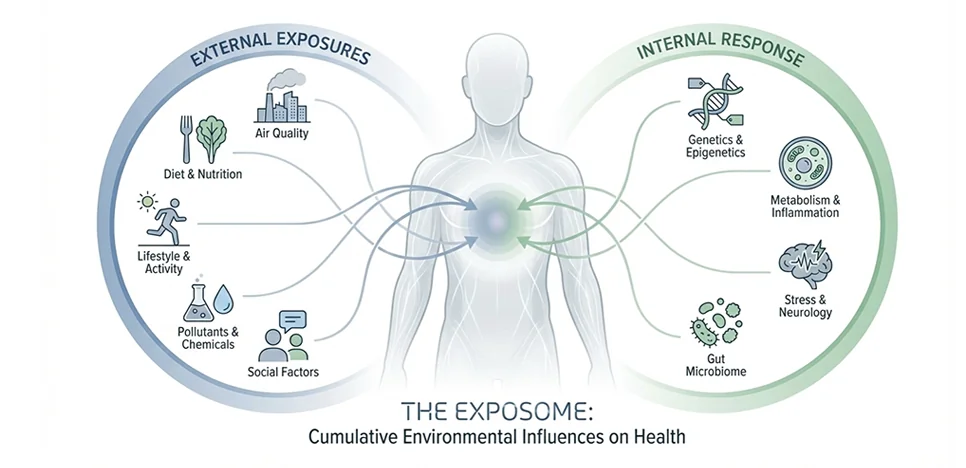
The Three Layers of the Exposome
For drug developers, it helps to think of the exposome in three domains:
- General external: air quality, water contamination, built environment
- Specific external: diet, occupation, consumer product use
- Internal response: biotransformation products, oxidative stress markers, metabolic shifts
Most pharmaceutical applications focus on the specific and internal domains, where chemical exposure intersects directly with therapeutic response.
Why Exposomics Is Gaining Momentum Now
The technology is ready.
Modern LC–MS platforms can:
- Detect hundreds to thousands of priority environmental chemicals
- Measure concentrations from parts-per-trillion to parts-per-million
- Integrate seamlessly into multi-omics workflows
Specialized exposomics services now provide:
- Targeted PFAS and pesticide panels
- Broad discovery screening
- Quantitative environmental biomarker profiling
- Multi-omics integration
This is no longer theoretical.
It’s operational.
Precision Medicine Needs an Environmental Dimension
Genomics tells us what we inherit.
Exposomics tells us what we accumulate.
Metabolomics connects the two by measuring the dynamic biochemical state that results from gene–environment interaction.
True precision medicine requires both.
When environmental exposures account for most disease variability and treatment heterogeneity, ignoring them limits clinical insight and therapeutic performance.
The future of drug development is not genomics versus environment.
It’s integration.
Moving Forward
Environmental chemical profiling adds biological context to every research program from neurodegeneration to oncology, metabolic disease to immunology.
As regulatory frameworks begin recognizing environmental biomarkers, early adopters will gain a strategic advantage in:
- Trial design
- Patient selection
- Mechanistic understanding
- Competitive positioning
The genome was only the beginning.
The exposome is the other half of human biology.
Panome Bio offers comprehensive Exposomics services. Our curated library of priority environmental contaminants, advanced metabolomics capabilities, and expertise in multi-omics integration enable researchers to incorporate environmental context into drug development programs.
Frequently Asked Questions
What is the exposome?
The exposome is the systematic measurement of environmental chemical exposures and their biological effects, encompassing substances like PFAS compounds, pesticides, plasticizers, flame retardants, and food additives that a person accumulates over a lifetime, measured through advanced mass spectrometry analysis.
How much of disease risk is explained by genetics versus environmental exposure?
Genetics typically explains only 10-30% of disease risk for common conditions like Type 2 diabetes and Alzheimer’s disease, while environmental factors are estimated to account for 70-90% of disease drivers not explained by genetics — making exposure history a major, often overlooked, contributor to chronic disease.
How does Panome Bio measure the exposome?
Panome Bio uses high-resolution LC-MS technology to simultaneously capture endogenous metabolic shifts and external chemical exposure signatures within the same biospecimen, enabling detection of thousands of exogenous compounds at trace levels alongside a person’s normal metabolome.
Why should pharmaceutical companies incorporate exposome data into drug development?
Exposome data can improve patient stratification in clinical trials, help explain geographic variation in drug response, support biomarker development, and help predict drug safety issues that arise from chemical co-exposures — factors that purely genetic or metabolic data alone would miss.
What evidence links chemical exposure to chronic disease risk?
Twin studies consistently show that most variability in common disease risk comes from environmental rather than inherited factors, reinforcing that chemical exposure, not genetics, is often the dominant driver behind conditions like metabolic disease and neurodegeneration.