
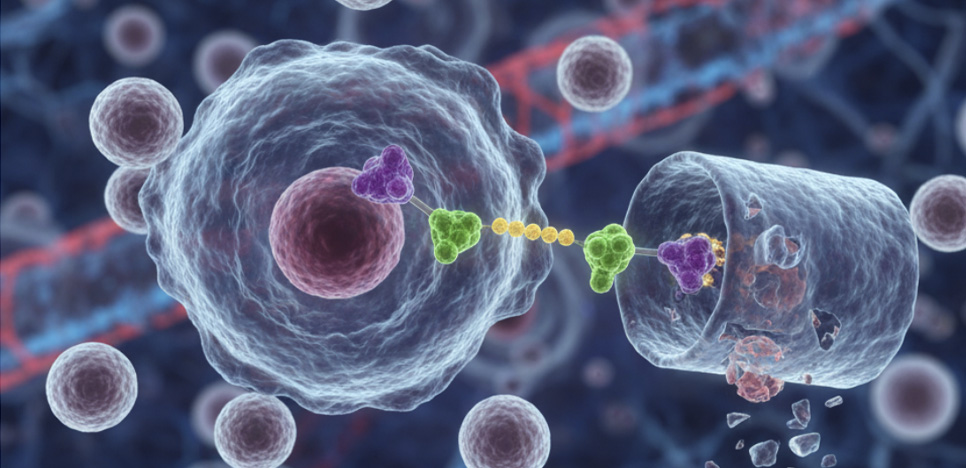
Proteolysis targeting chimeras (PROTACs) represent a revolutionary approach to targeted protein degradation, offering unprecedented opportunities to modulate previously “undruggable” targets in cancer and other diseases. As PROTAC research progresses from academic discovery to clinical translation, the complexity of understanding their mechanisms of action, selectivity profiles, and therapeutic effects has grown exponentially. Discovery proteomics, offered as a full-service assay by Panome Bio, has emerged as an indispensable analytical platform for PROTAC researchers, providing comprehensive insights into protein degradation pathways, off-target effects, and cellular responses that traditional biochemical approaches cannot capture. The integration of advanced mass spectrometry-based proteomics with PROTAC drug discovery has become essential for optimizing these complex molecules and accelerating their path to clinical success.
Mass Spectrometry-Based Proteomics for PROTAC Mechanism Studies
The foundation of PROTAC proteomics lies in mass spectrometry-based approaches that enable comprehensive analysis of protein degradation events and their downstream consequences. LC-MS proteomics CRO services have become essential partners for PROTAC researchers who require specialized expertise in targeted protein degradation proteomics. Their analytical platforms utilize advanced instrumentation including Orbitrap proteomics systems and timsTOF proteomics technologies to achieve the sensitivity and specificity needed for PROTAC mechanism of action studies.
The application of DIA proteomics (data-independent acquisition) has proven particularly valuable for PROTAC selectivity studies, as it enables comprehensive and reproducible quantification of protein changes across multiple treatment conditions and time points. This approach is especially critical for understanding the kinetics of protein degradation and the duration of PROTAC effects in cellular systems.
Ubiquitin-Proteasome System Analysis and E3 Ligase Proteomics
Understanding PROTAC mechanism of action requires detailed analysis of the ubiquitin-proteasome system and the specific E3 ligases recruited by these degrader molecules. E3 ligase proteomics has emerged as a specialized area of study, focusing on the characterization of E3 ligase-substrate interactions and the efficiency of ternary complex formation. Ubiquitin proteomics services enable researchers to track protein ubiquitination events, monitor proteasomal degradation pathways, and identify the specific ubiquitin linkages involved in PROTAC-mediated protein degradation. These studies are essential for optimizing PROTAC design and understanding why certain protein targets are more amenable to degradation than others.
Protein turnover proteomics represents another critical application, allowing researchers to measure the dynamics of protein synthesis and degradation in response to PROTAC treatment. This approach provides insights into cellular adaptation mechanisms and helps identify optimal dosing regimens for therapeutic applications.
Cancer Proteomics Applications for PROTAC Research
Panome Bio’s proteomics CRO services are instrumental in advancing PROTAC research for oncology applications, where the majority of clinical development efforts are currently focused. Oncology proteomics services enable comprehensive characterization of PROTAC effects in cancer cell line models, patient-derived xenografts, and clinical samples. Tumor proteomics analysis provides critical insights into how PROTACs modulate cancer-specific signaling pathways, identify biomarkers of response, and reveal mechanisms of resistance.
Cancer cell line proteomics studies are particularly valuable for PROTAC optimization, allowing researchers to compare degradation efficiency across different cancer types and genetic backgrounds. These studies help identify which cancer subtypes are most likely to respond to specific PROTAC therapies and guide patient stratification strategies for clinical trials.
Biomarker Discovery and Therapeutic Proteomics
As PROTACs advance toward clinical applications, biomarker discovery proteomics has become increasingly important for identifying predictive markers of therapeutic response and monitoring treatment effects. Discovery proteomic services specialize in optimizing assays that can be translated from preclinical models to clinical settings, enabling the development of companion diagnostics and pharmacodynamic biomarkers for PROTAC therapies.
PROTAC bioanalysis encompasses both the measurement of PROTAC exposure and the assessment of pharmacodynamic effects through protein degradation markers. This integrated approach is essential for establishing exposure-response relationships and optimizing dosing strategies in clinical development.
Integration with Metabolomics for Comprehensive PROTAC Characterization
The integration of PROTAC metabolomics services with proteomics approaches provides a more complete picture of cellular responses to protein degradation. Panome Bio’s Next-Generation Metabolomics studies can reveal how protein degradation affects cellular metabolism, energy production, and biosynthetic pathways. Panome’s metabolomics services complement proteomics analysis by identifying metabolic biomarkers of PROTAC response and revealing metabolic vulnerabilities that could be exploited therapeutically.
Protein degradation metabolomics studies are particularly valuable for understanding the functional consequences of target protein loss, as metabolic changes often provide a sensitive readout of pathway modulation that may not be captured through protein-level analysis alone.
Future Directions and Emerging Technologies
The future of PROTAC research will increasingly rely on advanced discovery proteomics approaches that can provide insights into protein degradation events and their cellular consequences. Emerging technologies including advanced computational approaches for data integration will continue to enhance our understanding of PROTAC mechanisms and guide the development of next-generation protein degraders. As the field moves toward more sophisticated PROTAC designs and combination therapies, the role of Panome Bio’s discovery proteomics in supporting these advances will only continue to grow, making it an indispensable tool for the PROTAC research community.